
Unlocking Cloud-Native Agility: Building Event-Driven Serverless Microservices

The Core Principles of Event-Driven Serverless Architecture
At its foundation, this architecture decouples application components, allowing them to communicate asynchronously via events. An event is any significant change in state, such as a file upload, a database update, or an API call. Serverless functions, ephemeral and stateless, are triggered by these events to execute specific business logic. This model inherently provides scalability and resilience, as functions scale to zero when idle and automatically parallelize in response to event volume. This approach is championed by leading cloud computing solution companies to maximize resource efficiency and developer agility.
Consider a data engineering pipeline for processing customer loyalty data. A user action on a mobile app generates an event published to a messaging stream like AWS Kinesis or Google Pub/Sub. This event triggers a serverless function (e.g., AWS Lambda) that enriches the data and stores it in a cloud data warehouse. This function’s success then emits a new event, triggering a second function that updates a customer’s points in a loyalty cloud solution. The entire workflow is orchestrated by events, not a monolithic application, ensuring loose coupling and independent scalability.
- Decoupling: Producers of events have no knowledge of the consumers. This isolation allows teams to develop, deploy, and scale microservices independently, a key advantage promoted by modern cloud computing solution companies.
- Event-Driven Triggers: Functions are invoked in response to events from various sources: HTTP gateways, message queues, database streams, or cloud storage events.
- Statelessness: Each function execution is independent. Any required state must be externalized to a database or cache, which is a key consideration for cloud computing solution companies when designing durable workflows.
- Scalability & Cost-Efficiency: Resources are allocated dynamically in response to the event rate. You pay only for the compute time consumed during execution, not for idle servers.
Here is a simplified code snippet for an AWS Lambda function triggered by an S3 file upload, a common pattern for data ingestion and a foundational element in a reliable backup cloud solution strategy for data workflows:
import json
import boto3
from processors import transform_data

s3_client = boto3.client('s3')
def lambda_handler(event, context):
    # Parse the S3 event
    for record in event['Records']:
        bucket = record['s3']['bucket']['name']
        key = record['s3']['object']['key']

        # Get the uploaded file
        response = s3_client.get_object(Bucket=bucket, Key=key)
        file_content = response['Body'].read().decode('utf-8')

        # Process the data
        transformed_data = transform_data(file_content)

        # Store result or trigger next step
        # ... (e.g., save to DynamoDB, publish to another stream)

        # For resilience, log the event to a secondary system as part of a backup cloud solution
        log_to_backup_stream(bucket, key, context.aws_request_id)
The measurable benefits are substantial. Development velocity increases as teams focus on business logic in discrete functions. Operational overhead plummets as the cloud provider manages servers. Resilience is enhanced; if one function fails, events can be retried or routed to a backup cloud solution like a dead-letter queue (DLQ) for analysis. For instance, a failed loyalty point update event in a loyalty cloud solution can be queued and reprocessed without bringing down the entire system, ensuring data consistency and customer satisfaction.
To implement this, start by modeling your business processes as a series of state changes. Identify event sources and define the schema for your event payloads. Use infrastructure-as-code (e.g., Terraform, AWS SAM) to deploy your functions and their triggers. Finally, implement robust observability with distributed tracing and centralized logging to monitor the event flow across your serverless microservices. Partnering with established cloud computing solution companies can accelerate this process through their managed services and best practices.
Defining the Event-Driven Paradigm for Modern Cloud Solutions
At its core, the event-driven paradigm is a software architecture pattern where the flow of the application is determined by events—discrete, significant changes in state. In cloud-native systems, these events—like a file upload, a database update, or an API call—trigger autonomous, loosely coupled services. This model is fundamental for building responsive, scalable systems that align perfectly with serverless and microservices principles. For cloud computing solution companies, promoting this architecture is key, as it maximizes the utility of their managed services, turning them into a cohesive, reactive platform. It transforms their offerings into more than just infrastructure, enabling true business agility.
Consider a data engineering pipeline. A raw data file is uploaded to cloud storage. This action generates an event. A serverless function, listening for that event, is automatically invoked. It processes the file and inserts records into a database. The database update then emits another event, triggering a second function that aggregates the data and updates a dashboard. This decoupled chain is resilient; if the aggregation service fails, the events will queue and retry, acting as a built-in backup cloud solution for data flow without manual intervention. This inherent resilience is a major selling point for cloud computing solution companies advocating for event-driven designs.
Here is a simplified, step-by-step implementation using AWS services, a common stack from leading cloud computing solution companies:
- A user uploads a
sales.csvfile to an Amazon S3 bucket. - S3 automatically publishes an
ObjectCreatedevent to Amazon EventBridge. - An EventBridge rule routes the event to an AWS Lambda function.
The Lambda function, written in Python, is triggered and processes the file:
import boto3
import pandas as pd
import json

s3_client = boto3.client('s3')
dynamodb = boto3.resource('dynamodb')
table = dynamodb.Table('ProcessedSales')
eventbridge = boto3.client('events')

def lambda_handler(event, context):
    # Get bucket and file key from the event
    bucket = event['detail']['bucket']['name']
    key = event['detail']['object']['key']

    try:
        # Read the CSV directly from S3
        obj = s3_client.get_object(Bucket=bucket, Key=key)
        df = pd.read_csv(obj['Body'])

        # Perform transformation: calculate total per customer
        aggregated = df.groupby('customer_id')['amount'].sum().reset_index()

        # Write results to DynamoDB
        for _, row in aggregated.iterrows():
            table.put_item(Item={
                'customer_id': str(row['customer_id']),
                'lifetime_value': str(row['amount']),
                'source_file': key
            })

        # Emit a new event for downstream services, such as a loyalty cloud solution
        response = eventbridge.put_events(
            Entries=[
                {
                    'Source': 'data.processor',
                    'DetailType': 'CustomerLifetimeValueUpdated',
                    'Detail': json.dumps({
                        'customer_id': row['customer_id'],
                        'updated_value': str(row['amount'])
                    }),
                    'EventBusName': 'default'
                }
            ]
        )
        print(f"Processed {key} and updated customer totals. Event published.")

    except Exception as e:
        print(f"Error processing {key}: {e}")
        # Send failure details to a backup cloud solution (e.g., SQS DLQ)
        raise e
The measurable benefits of this paradigm are clear:
- Scalability: Services scale independently to the rate of events. The Lambda function above can process ten files or ten thousand concurrently.
- Resilience: Failure in one component doesn’t cascade. Events persist until processed, ensuring durability and providing a natural backup cloud solution for in-flight data.
- Agility & Developer Velocity: Teams can develop, deploy, and update services independently, as long as they adhere to the event contract.
- Cost-Efficiency: Serverless resources incur cost only when reacting to events, eliminating idle compute spend.
For a loyalty cloud solution, this is transformative. A customer’s purchase (event) can immediately trigger points calculation, tier promotion checks, and notification dispatch through separate, manageable functions. This real-time responsiveness enhances customer experience while keeping the system modular and adaptable to new business rules. By embracing events, you move from monolithic, scheduled batch operations to a dynamic, reactive data mesh that is the hallmark of true cloud-native agility, a vision consistently pushed forward by innovative cloud computing solution companies.
How Serverless Computing Enables True Microservices Agility
Serverless computing fundamentally shifts the operational model for microservices by abstracting away infrastructure management. This allows development teams to focus solely on business logic, accelerating the path from code to production. Each function or service can be developed, deployed, and scaled independently, embodying the core promise of microservices: true agility. This is a primary reason why cloud computing solution companies like AWS, Google Cloud, and Microsoft Azure heavily invest in serverless platforms; they provide the granular, event-driven fabric that microservices need to thrive. The serverless model turns infrastructure into a utility, enabling developers to build complex systems like a loyalty cloud solution with unprecedented speed.
Consider a data engineering pipeline for processing customer loyalty events. Instead of managing long-running container clusters, you build discrete, serverless functions. A step-by-step implementation might look like this:
- An event, such as „Points_Earned,” is published to a messaging stream like Amazon Kinesis Data Streams.
- This event triggers a serverless function (e.g., an AWS Lambda) that validates and enriches the data.
- The function then asynchronously invokes another serverless service, like a dedicated loyalty points calculator.
- Finally, the result is stored in a database, and a notification is sent via a serverless workflow. All state changes are also logged to a durable store as part of a backup cloud solution strategy.
Here is a simplified code snippet for the initial event handler in Python, demonstrating the decoupled nature of a loyalty cloud solution:
import json
import boto3
import logging

logger = logging.getLogger()
logger.setLevel(logging.INFO)

kinesis = boto3.client('kinesis')
eventbridge = boto3.client('events')

def is_valid_loyalty_event(payload):
    # Implement validation logic
    required_fields = ['customer_id', 'transaction_id', 'points']
    return all(field in payload for field in required_fields)

def publish_to_event_bus(event_detail):
    # Publish enriched event for further processing
    eventbridge.put_events(
        Entries=[
            {
                'Source': 'loyalty.validator',
                'DetailType': 'LoyaltyEventValidated',
                'Detail': json.dumps(event_detail),
                'EventBusName': 'loyalty-bus'
            }
        ]
    )

def lambda_handler(event, context):
    logger.info(f"Processing {len(event['Records'])} records")
    processed_count = 0
    error_count = 0

    # Process records from the Kinesis stream
    for record in event['Records']:
        try:
            payload = json.loads(record['kinesis']['data'])
            # Business logic: validate loyalty event
            if is_valid_loyalty_event(payload):
                # Enrich with additional data (e.g., from a customer profile DB)
                payload['validated_at'] = context.aws_request_id
                # Publish to next step
                publish_to_event_bus(payload)
                processed_count += 1
            else:
                logger.warning(f"Invalid event payload: {payload}")
                # Route invalid events to a DLQ as part of a backup cloud solution
                send_to_dlq(payload, "Validation failed")
                error_count += 1
        except Exception as e:
            logger.error(f"Error processing record: {e}")
            error_count += 1

    return {
        'statusCode': 200,
        'body': json.dumps({
            'processed': processed_count,
            'errors': error_count
        })
    }
The measurable benefits are clear. Cost efficiency is achieved by paying only for millisecond-level execution time, not for idle servers. Elastic scalability is automatic and instantaneous for each service, preventing bottlenecks. This inherent resilience also acts as a powerful backup cloud solution at the code level; if one function fails, the event-driven architecture allows for retries and dead-letter queues without bringing down the entire system. This decoupled nature means a failure in the points calculation service doesn’t crash the event ingestion service, a critical feature for a reliable loyalty cloud solution.
For implementing a comprehensive loyalty cloud solution, this serverless microservices approach is ideal. Marketing teams can independently update a promotional campaign function, while data engineers can modify the data aggregation service, all without coordinated deployments. The entire system’s agility is unlocked because the unit of deployment is small, focused, and managed by the cloud provider. This reduces operational overhead, shifts focus to feature velocity, and creates a system where change is the default, safe, and rapid. The result is an architecture that is not just cloud-native, but inherently agile and resilient, precisely what forward-thinking cloud computing solution companies aim to deliver.
Designing Your Event-Driven Serverless cloud solution
When architecting an event-driven serverless system, the core principle is to design loosely coupled, reactive components. Begin by identifying the events—state changes or significant occurrences like a file upload, a database update, or an API call. These events become the communication fabric. For instance, in a customer data pipeline, an event could be CustomerProfileUpdated. This event is published to a managed messaging service like AWS EventBridge or Azure Event Grid, decoupling the service that made the change from those that need to react. This design pattern is central to the offerings of modern cloud computing solution companies, enabling complex systems like a loyalty cloud solution to be built from independent, scalable parts.
A critical step is selecting the right managed services from leading cloud computing solution companies like AWS, Google Cloud, and Microsoft Azure. Your architecture will combine services such as:
– Function-as-a-Service (FaaS): AWS Lambda, Azure Functions, or Google Cloud Functions to execute stateless business logic.
– Event Brokers & Buses: AWS EventBridge, Google Pub/Sub, or Apache Kafka on a managed service (e.g., Confluent Cloud) for routing events.
– Data Stores: Serverless databases (Amazon DynamoDB, Google Firestore) or data warehouses (Snowflake, BigQuery) for state persistence.
– Orchestration: AWS Step Functions or Google Cloud Workflows for coordinating multi-step processes.
Consider a practical example for a loyalty cloud solution. When a user completes a purchase, an order service emits a PurchaseCompleted event containing user_id and points_earned. An AWS Lambda function, triggered by this event in EventBridge, calculates and updates the user’s loyalty points in DynamoDB.
Here is a detailed code snippet for that Lambda function in Python, including error handling and integration with a backup cloud solution:
import json
import boto3
from decimal import Decimal
from datetime import datetime

dynamodb = boto3.resource('dynamodb')
table = dynamodb.Table('LoyaltyPoints')
s3 = boto3.client('s3')  # For backup archival

def archive_to_backup(payload, reason):
    # Archival to S3 as part of a comprehensive backup cloud solution
    backup_key = f"backup/errors/{datetime.utcnow().isoformat()}.json"
    s3.put_object(
        Bucket='loyalty-backup-bucket',
        Key=backup_key,
        Body=json.dumps({
            'reason': reason,
            'payload': payload,
            'timestamp': datetime.utcnow().isoformat()
        })
    )

def lambda_handler(event, context):
    # Parse the event from EventBridge
    try:
        detail = event['detail']
        user_id = detail['user_id']
        # Ensure points are handled as Decimal for DynamoDB
        points = Decimal(str(detail['points_earned']))

        # Update points in DynamoDB
        response = table.update_item(
            Key={'userId': user_id},
            UpdateExpression="ADD points :val SET lastUpdated = :now",
            ExpressionAttributeValues={
                ':val': points,
                ':now': datetime.utcnow().isoformat()
            },
            ReturnValues="UPDATED_NEW"
        )

        print(f"Successfully updated points for user {user_id}. New total: {response['Attributes']['points']}")
        return {
            'statusCode': 200,
            'body': json.dumps(response['Attributes'])
        }

    except KeyError as e:
        print(f"Malformed event: missing key {e}")
        archive_to_backup(event, f"MalformedEvent-{e}")
        raise
    except Exception as e:
        print(f"Error updating points: {e}")
        archive_to_backup(event, f"ProcessingError-{type(e).__name__}")
        # Re-raise the exception to allow the Lambda service to retry or send to DLQ
        raise e
To ensure resilience, always implement a backup cloud solution for your event data and state. This is not just about traditional database backups. For event-driven systems, you must enable event replayability. Configure your event streams with sufficient retention periods (e.g., 7 days in Kafka) and archive critical event payloads to cold storage like Amazon S3 Glacier. This allows you to rebuild stateful projections or recover from logic errors by replaying historical events, a practice strongly recommended by experienced cloud computing solution companies.
The measurable benefits of this design are substantial. You achieve automatic scaling, where each component scales independently to zero based on event volume, optimizing cost. Development velocity increases as teams can deploy and update functions without managing servers. Furthermore, system resilience improves; the failure of one Lambda function doesn’t block the event bus, and events can be retried or sent to a dead-letter queue for analysis. By leveraging the managed services from major providers, your team focuses on business logic—such as the intricate rules of a loyalty cloud solution—rather than infrastructure plumbing, unlocking true cloud-native agility.
Key Components: Event Producers, Brokers, and Serverless Consumers
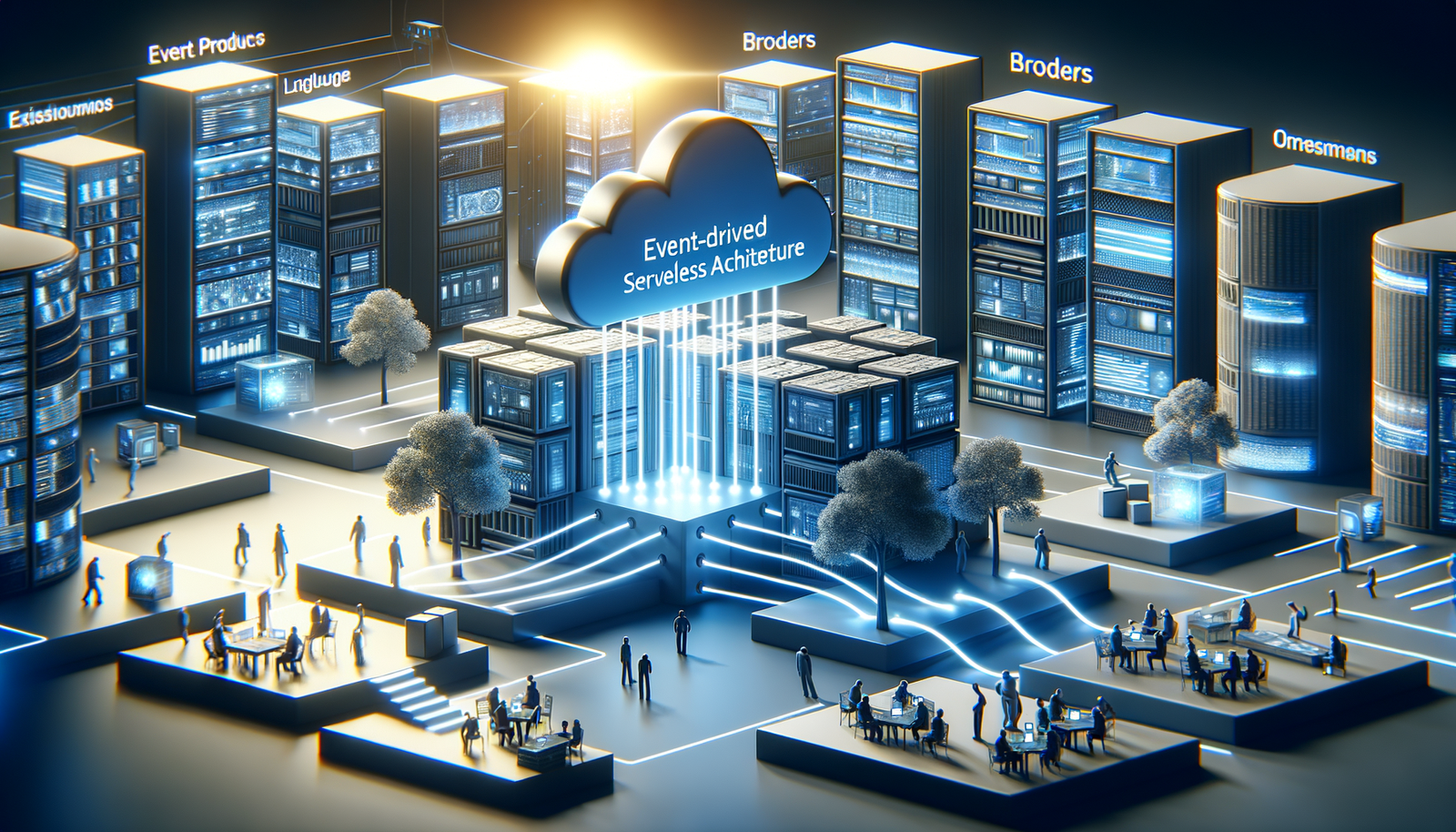
An event-driven serverless architecture relies on three core pillars working in concert. Event Producers are services or applications that emit events—state changes or significant occurrences—into the system. These can be user actions, database updates, IoT sensor readings, or scheduled tasks. For instance, an e-commerce service acts as a producer when a new order is placed, publishing an OrderCreated event. This decouples the order processing logic from the checkout service, a fundamental principle for a resilient cloud computing solution.
- Example Producer (AWS SDK for Python – Boto3):
import boto3
import json
import uuid

client = boto3.client('events')

def publish_order_event(customer_id, total_amount):
    event_id = str(uuid.uuid4())
    response = client.put_events(
        Entries=[
            {
                'Source': 'com.orders.service',
                'DetailType': 'OrderCreated',
                'Detail': json.dumps({
                    'orderId': event_id,
                    'customerId': customer_id,
                    'totalAmount': total_amount,
                    'currency': 'USD'
                }),
                'EventBusName': 'default'
            }
        ]
    )
    if response['FailedEntryCount'] > 0:
        print(f"Failed to publish event: {response['Entries']}")
        # Implement fallback to a backup cloud solution (e.g., direct SQS queue)
    else:
        print(f"Successfully published order event {event_id}")
    return response
The Event Broker (or Event Router) is the central nervous system. It receives events from producers, persists them if needed, and routes them to interested consumers. Popular brokers include Apache Kafka, AWS EventBridge, and Google Pub/Sub. They provide durability, fan-out capabilities, and ordering guarantees. For mission-critical systems, a robust broker acts as a backup cloud solution, ensuring no event is lost even if a consumer is temporarily unavailable, by leveraging features like dead-letter queues, persistent storage, and multi-zone replication offered by cloud computing solution companies.
Consumers are the Serverless Functions that are triggered by events. They are stateless, scalable, and you pay only for their execution time. An event from the broker automatically invokes the function, which processes the payload. This is where business logic resides, such as updating a loyalty points database or initiating a shipment.
-
Step-by-Step Consumer Setup (AWS Lambda with EventBridge trigger):
- In the AWS Lambda console, create a new function (e.g.,
ProcessLoyaltyPoints). Choose a runtime like Python 3.9 or Node.js 16.x. - In the function designer, add a trigger and select EventBridge (CloudWatch Events).
- Create a new rule. For the event pattern, use a JSON structure to match events from the source
com.orders.serviceand detail-typeOrderCreated. - Configure the rule to trigger your Lambda function.
- Set up a Dead Letter Queue (DLQ) for the function, such as an SQS queue or another S3 bucket, to act as your backup cloud solution for failed invocations.
- Implement your consumer logic in the function handler.
- In the AWS Lambda console, create a new function (e.g.,
-
Example Consumer Logic (Node.js 18.x):
const AWS = require('aws-sdk');
const dynamoDB = new AWS.DynamoDB.DocumentClient();
const tableName = 'LoyaltyPoints';

exports.handler = async (event) => {
    console.log('Received event:', JSON.stringify(event, null, 2));
    const orderDetail = event.detail;

    try {
        // Business logic: Calculate points (e.g., 1 point per dollar)
        const pointsEarned = Math.floor(orderDetail.totalAmount);
        const customerId = orderDetail.customerId;

        const params = {
            TableName: tableName,
            Key: { customerId: customerId },
            UpdateExpression: 'ADD points :p',
            ExpressionAttributeValues: {
                ':p': pointsEarned
            },
            ReturnValues: 'UPDATED_NEW'
        };

        const result = await dynamoDB.update(params).promise();
        console.log(`Successfully updated points for ${customerId}. New total: ${result.Attributes.points}`);

        // Emit a subsequent event for a loyalty cloud solution (e.g., tier check)
        // ... publish to EventBridge ...

        return { statusCode: 200, body: `Processed order ${orderDetail.orderId}` };
    } catch (error) {
        console.error('Error processing loyalty points:', error);
        // The event and error context should be captured by the DLQ backup cloud solution
        throw error; // Lambda will retry and then send to DLQ
    }
};
The measurable benefits are clear. This pattern enables cloud computing solution companies to build systems that scale dynamically with load, as each component scales independently. Development velocity increases because teams can deploy and update consumers without impacting producers. For a business implementing a loyalty cloud solution, this architecture allows seamless integration of new loyalty rules or partner promotions by simply adding new serverless consumers that subscribe to the relevant OrderCreated or PaymentProcessed events, without modifying the core transactional systems. The result is a highly agile, resilient, and cost-efficient microservices ecosystem.
Architectural Patterns: Event Sourcing and CQRS in Practice
In modern cloud-native applications, combining Event Sourcing and Command Query Responsibility Segregation (CQRS) creates a robust foundation for scalable, event-driven microservices. Event Sourcing persists the state of a business entity as a sequence of immutable state-changing events. Instead of storing just the current state in a database, the system stores every change as an event object in an event store. This log becomes the single source of truth, enabling perfect audit trails and temporal queries. CQRS complements this by separating the model for updating information (the command side) from the model for reading information (the query side). This separation allows each side to be optimized independently, scaling reads and writes based on demand, a pattern frequently utilized in sophisticated platforms built by cloud computing solution companies.
Consider a loyalty points system, a common feature managed by loyalty cloud solution providers. Implementing this with Event Sourcing and CQRS in a serverless environment provides clear benefits.
- Command Side (Write Model): A
AddLoyaltyPointsCommandis received via an API Gateway, triggering a Lambda function. This function validates the command, loads the customer’s aggregate from the event stream (e.g., from a stream namedCustomerLoyalty-123in Amazon DynamoDB Streams), and executes the business logic. If valid, it appends a newPointsAddedevent to the stream in a durable event store.
Code Snippet (Conceptual Lambda Handler in Python using a library likeeventsourcing):
from eventsourcing.application import Application
from eventsourcing.persistence import IntegrityError

class LoyaltyApplication(Application):
    def add_points(self, customer_id, points, reason):
        try:
            # Load the aggregate (customer's loyalty account) from its event stream
            loyalty_account = self.repository.get(customer_id)
        except Exception:
            # Aggregate not found, create a new one
            loyalty_account = LoyaltyAccount(customer_id)

        # Business logic: apply the command to the aggregate
        loyalty_account.add_points(points, reason)

        # Save the new events generated by the aggregate
        self.save(loyalty_account)
        return loyalty_account

# Lambda Handler
def lambda_handler(event, context):
    app = LoyaltyApplication()
    command = json.loads(event['body'])
    try:
        loyalty_account = app.add_points(
            command['customerId'],
            command['points'],
            command['reason']
        )
        return {'statusCode': 200, 'body': json.dumps({'currentPoints': loyalty_account.points})}
    except IntegrityError as e:
        return {'statusCode': 400, 'body': json.dumps({'error': str(e)})}
-
Event Publishing: The newly appended event is automatically published to a messaging channel like Amazon EventBridge or a Kinesis stream. This decouples the command side from subsequent processing and provides a natural backup cloud solution in the form of an immutable, replayable log.
-
Query Side (Read Model): Separate subscriber Lambda functions, acting as projections, listen for
PointsAddedevents. They update optimized, denormalized read models (e.g., a DynamoDB table structured for fast queries by customer ID and date). This table powers dashboards and APIs without impacting the write model’s performance. For a loyalty cloud solution, this could be aCustomerLoyaltySummarytable used by a customer-facing portal.
The measurable benefits are significant. Scalability: Reads can be scaled independently using caching and read replicas, a principle leveraged by top cloud computing solution companies. Resilience: The immutable event log acts as a perfect backup cloud solution for state recovery; you can rebuild any read model by replaying events, which is invaluable for disaster recovery or debugging. Flexibility: New features (e.g., a new „points expiration” projection) can be added by simply subscribing to the existing event stream, enabling rapid iteration without touching the core command logic.
In practice, for a data engineering team, this pattern ensures data integrity and provides a rich history for analytics. Event streams feed data warehouses for complex historical analysis, turning operational data into a strategic asset. While introducing complexity, the payoff in auditability, scalability, and business agility in a serverless cloud environment is substantial, making it a compelling choice for complex domains like a loyalty cloud solution.
Implementing a Technical Walkthrough: A Real-World Cloud Solution
Let’s build a real-world event-driven serverless microservice for a customer loyalty cloud solution. This system processes customer transactions to update loyalty points in real-time. We’ll architect this using AWS, a leader among cloud computing solution companies, ensuring resilience with a backup cloud solution pattern. This walkthrough will cover event ingestion, processing, data persistence, and error handling.
Our architecture uses AWS Lambda for compute, Amazon EventBridge for event routing, and DynamoDB for persistence. The flow begins when a purchase event is published to an EventBridge event bus.
- Event Ingestion: A point-of-sale system publishes a JSON event to a custom EventBridge bus. The event detail contains
customerId,transactionId, andpurchaseAmount. This decouples the POS system from the loyalty logic.
Example Event Payload:
{
  "detail-type": "customer.purchase.completed",
  "source": "pos.system",
  "detail": {
    "customerId": "cust_12345",
    "transactionId": "txn_67890",
    "purchaseAmount": 150.00,
    "items": [
      { "sku": "ITEM_001", "price": 75.00 },
      { "sku": "ITEM_002", "price": 75.00 }
    ]
  }
}
-
Serverless Processing: An EventBridge rule matches the event pattern and triggers a Lambda function. This function contains our business logic: calculating points (e.g., 1 point per dollar) and updating the customer record. We also implement idempotency using the
transactionIdto prevent duplicate processing.Lambda Function Snippet (Python with idempotency and backup):
import boto3
import json
from decimal import Decimal
from datetime import datetime

dynamodb = boto3.resource('dynamodb')
loyalty_table = dynamodb.Table('LoyaltyPoints')
processed_transactions_table = dynamodb.Table('ProcessedTransactions')  # Idempotency table

def lambda_handler(event, context):
    detail = event['detail']
    customer_id = detail['customerId']
    transaction_id = detail['transactionId']
    points_to_add = int(detail['purchaseAmount'])  # 1 point per dollar

    # 1. Idempotency Check - prevent duplicate processing
    try:
        processed_transactions_table.put_item(
            Item={'transactionId': transaction_id, 'processedAt': datetime.utcnow().isoformat()},
            ConditionExpression='attribute_not_exists(transactionId)'
        )
    except dynamodb.meta.client.exceptions.ConditionalCheckFailedException:
        print(f"Transaction {transaction_id} already processed. Skipping.")
        return {'statusCode': 200, 'body': 'Transaction already processed'}

    try:
        # 2. Update Loyalty Points
        response = loyalty_table.update_item(
            Key={'customerId': customer_id},
            UpdateExpression="ADD points :val SET lastUpdated = :now, lastTransaction = :tx",
            ExpressionAttributeValues={
                ':val': Decimal(points_to_add),
                ':now': datetime.utcnow().isoformat(),
                ':tx': transaction_id
            },
            ReturnValues="UPDATED_NEW",
            ConditionExpression='attribute_exists(customerId)'  # Assumes customer profile exists
        )
        print(f"Updated points for {customer_id}. New total: {response['Attributes']['points']}")

        # 3. (Optional) Publish a "PointsAwarded" event for other services
        # ...

        return {'statusCode': 200, 'body': json.dumps(response['Attributes'])}

    except dynamodb.meta.client.exceptions.ConditionalCheckFailedException:
        # Handle missing customer profile - send to a remediation queue as part of backup cloud solution
        send_to_remediation_queue(detail, "Customer profile not found")
        return {'statusCode': 404, 'body': 'Customer not found'}
    except Exception as e:
        print(f"Error updating points for transaction {transaction_id}: {e}")
        # 4. On failure, delete the idempotency key to allow retry, AND archive the event
        processed_transactions_table.delete_item(Key={'transactionId': transaction_id})
        archive_failed_event_to_s3(event, e)  # Core part of the backup cloud solution
        raise e  # Trigger Lambda retry and eventual DLQ
-
Data Persistence & Resilience: The Lambda function updates the customer’s total points in a DynamoDB table. For fault tolerance, we configure the Lambda function with a dead-letter queue (DLQ), such as an Amazon SQS queue. If the function fails all retry attempts (typically 2), the event is automatically sent to the SQS DLQ. This SQS queue acts as our operational backup cloud solution, preserving failed events for audit, analysis, and manual or automated reprocessing, preventing data loss and ensuring system reliability.
-
Measurable Benefits: This serverless, event-driven approach delivers clear outcomes. Cost efficiency is achieved by paying only for millisecond-level Lambda executions and DynamoDB read/write units. Scalability is automatic; a surge in purchases triggers concurrent Lambda invocations without operational overhead. Development agility increases as teams can deploy and update the points calculator function independently of the POS system. The built-in backup cloud solution via DLQ and S3 archiving provides peace of mind and operational visibility.
By leveraging services from top cloud computing solution companies, we construct a robust loyalty cloud solution that is inherently scalable, cost-effective, and maintainable. The event-driven paradigm decouples components, while the serverless model eliminates infrastructure management, allowing data engineering teams to focus purely on delivering business logic and value.
Example: Building a Serverless Image Processing Pipeline
Let’s walk through a practical implementation of an event-driven serverless pipeline. Imagine an e-commerce platform where users upload product images. We need to automatically generate thumbnails, apply watermarks, and extract metadata. A traditional monolithic approach would require provisioning and managing servers, creating a scaling headache. Instead, we build an event-driven, serverless pipeline that is both scalable and cost-effective, utilizing standard services from cloud computing solution companies.
The architecture leverages AWS services, though the pattern is portable to Google Cloud or Azure. The flow is as follows:
- A user uploads an image to an Amazon S3 bucket named
raw-product-images. - This upload event automatically triggers an AWS Lambda function via an S3 event notification.
- The Lambda function, using a library like Pillow (PIL) in Python, processes the image (creates a thumbnail, adds a watermark).
- The processed images are saved to a different S3 bucket,
processed-images. - Finally, the function writes metadata (e.g., image dimensions, processing timestamp) to a database like Amazon DynamoDB. All original and processed assets are inherently part of a durable backup cloud solution thanks to S3’s 11 9’s durability.
Here is a simplified yet complete code snippet for the core Lambda function:
import boto3
from PIL import Image, ImageDraw, ImageFont
import io
import json
import logging
from urllib.parse import unquote_plus

logger = logging.getLogger()
logger.setLevel(logging.INFO)

s3_client = boto3.client('s3')
dynamodb = boto3.resource('dynamodb')
metadata_table = dynamodb.Table('ImageMetadata')

def add_watermark(image):
    """Adds a simple text watermark to the image."""
    draw = ImageDraw.Draw(image)
    # Use a default font; for production, package a .ttf file with your Lambda.
    try:
        font = ImageFont.truetype("arial.ttf", 36)
    except IOError:
        font = ImageFont.load_default()
    text = "SAMPLE WATERMARK"
    text_width, text_height = draw.textsize(text, font=font)
    position = (image.width - text_width - 10, image.height - text_height - 10)
    draw.text(position, text, fill=(255, 255, 255, 128), font=font)
    return image

def lambda_handler(event, context):
    for record in event['Records']:
        try:
            # 1. Parse the S3 event
            bucket = record['s3']['bucket']['name']
            key = unquote_plus(record['s3']['object']['key'])
            logger.info(f"Processing file: {key} from bucket: {bucket}")

            # 2. Download the image into memory
            file_obj = s3_client.get_object(Bucket=bucket, Key=key)
            file_content = file_obj['Body'].read()
            image = Image.open(io.BytesIO(file_content))

            # 3. Create Thumbnail (200x200)
            thumbnail = image.copy()
            thumbnail.thumbnail((200, 200))
            thumbnail_buffer = io.BytesIO()
            thumbnail.save(thumbnail_buffer, format=image.format or 'JPEG')
            thumbnail_buffer.seek(0)

            # Save thumbnail
            thumbnail_key = f"thumbnails/{key}"
            s3_client.put_object(
                Bucket='processed-images',
                Key=thumbnail_key,
                Body=thumbnail_buffer,
                ContentType=file_obj.get('ContentType', 'image/jpeg')
            )

            # 4. Create Watermarked Version
            watermarked = add_watermark(image.copy())
            watermark_buffer = io.BytesIO()
            watermarked.save(watermark_buffer, format=image.format or 'JPEG')
            watermark_buffer.seek(0)

            watermarked_key = f"watermarked/{key}"
            s3_client.put_object(
                Bucket='processed-images',
                Key=watermarked_key,
                Body=watermark_buffer,
                ContentType=file_obj.get('ContentType', 'image/jpeg')
            )

            # 5. Record Metadata in DynamoDB
            metadata_table.put_item(Item={
                'imageId': key,
                'originalBucket': bucket,
                'processedBucket': 'processed-images',
                'dimensions': {'width': image.width, 'height': image.height},
                'thumbnailPath': thumbnail_key,
                'watermarkedPath': watermarked_key,
                'processedTimestamp': context.aws_request_id,
                'fileSize': file_obj['ContentLength']
            })

            logger.info(f"Successfully processed {key}. Thumbnail: {thumbnail_key}, Watermarked: {watermarked_key}")

        except Exception as e:
            logger.error(f"Failed to process {key}: {e}")
            # Send failure notification to an SNS topic or SQS queue (backup cloud solution)
            send_processing_alert(bucket, key, str(e))
            raise  # Allows Lambda retry mechanism

    return {'statusCode': 200, 'body': 'Processing complete'}
This design delivers measurable benefits. Cost efficiency is achieved as you only pay for Lambda execution time and S3 storage, with zero idle costs. Elastic scalability is inherent; a surge in uploads triggers concurrent Lambda invocations, automatically scaling to thousands of requests per second without operator intervention. Operational simplicity removes the need to patch OSes or manage web servers.
Crucially, this entire pipeline is inherently a robust backup cloud solution. The original and processed assets are durably stored in S3, which offers 99.999999999% (11 9’s) durability across multiple Availability Zones. For a loyalty cloud solution that might process profile pictures or receipt scans for reward points, this reliability and hands-off management is critical. The event-driven nature also makes it easy to extend; you could add another Lambda function triggered by the DynamoDB stream to update a customer’s loyalty points based on a processed receipt image, further decoupling services and enhancing the agility of the overall loyalty cloud solution.
Integrating Cloud-Native Services for Event Routing and Processing
A robust event-driven architecture relies on a decoupled, scalable backbone for routing and processing messages. Major cloud computing solution companies like AWS, Google Cloud, and Microsoft Azure provide managed services that abstract the underlying infrastructure, allowing teams to focus on business logic. The core pattern involves an event producer, a routing service, and serverless consumers. For instance, an e-commerce system might emit an 'order.placed’ event whenever a transaction completes. This event needs to be routed to multiple downstream services for inventory update, payment processing, and customer notification—a perfect use case for a managed event bus.
A typical integration uses a managed message broker or event bus as the central nervous system. Consider this AWS example using Amazon EventBridge and AWS Lambda. First, define an event bus and a rule to route events matching a specific pattern to a target Lambda function. This setup is a cornerstone of agile architectures promoted by cloud computing solution companies.
- Step 1: Emit an event from a service. Your microservice publishes a JSON event to the default or a custom event bus. This is often done from within a Lambda function or a containerized application.
import boto3
import json
import uuid

client = boto3.client('events')

def publish_order_event(customer_id, items, total):
    event = {
        "Source": "orders.service",
        "DetailType": "OrderPlaced",
        "Detail": json.dumps({
            "orderId": str(uuid.uuid4()),
            "customerId": customer_id,
            "items": items,
            "total": total,
            "status": "PLACED"
        }),
        "EventBusName": "default"
    }
    try:
        response = client.put_events(Entries=[event])
        if response['FailedEntryCount'] == 0:
            print("Event published successfully.")
        else:
            print(f"Failed to publish event: {response['Entries']}")
            # Implement a fallback to a direct SQS queue as a backup cloud solution
            publish_to_sqs_fallback(event)
    except Exception as e:
        print(f"Error publishing event: {e}")
        # Log to a secondary monitoring system
- Step 2: Create a routing rule. In the EventBridge console or via Infrastructure as Code (IaC) like AWS CloudFormation or CDK, you create a rule that filters for events where
DetailTypeequals „OrderPlaced” and sets a Lambda function as the target. You can also set up multiple targets for fan-out patterns. - Step 3: Process with a serverless function. The triggered Lambda parses the event and executes its logic. This serverless execution model provides automatic scaling and cost-efficiency, charging only for the compute time consumed. The function should be designed to be idempotent and include failure handling that leverages a backup cloud solution like a DLQ.
The measurable benefits are significant. Teams achieve agility through independent deployment of producers and consumers. Scalability is inherent, as the cloud services handle traffic spikes seamlessly. Furthermore, this design inherently supports a backup cloud solution; by leveraging the cloud provider’s built-in redundancy, cross-region replication for event buses, and DLQs for functions, your event stream gains high durability and availability without custom engineering.
This pattern is particularly powerful for systems like a loyalty cloud solution. When a OrderPlaced event is routed, it can fan out to trigger multiple processes:
* A Lambda function calculates points and updates a customer’s profile in DynamoDB.
* Another function checks if the purchase qualifies for a promotional tier upgrade.
* A third function dispatches a „points-awarded” notification via Amazon SNS.
Each step is independent, allowing the loyalty cloud solution services to be updated or scaled without affecting the core ordering system. By leveraging these managed services from cloud computing solution companies, data engineering teams can build resilient, responsive systems that translate business events into immediate, actionable workflows, unlocking true cloud-native agility.
Conclusion: The Future of Agile Cloud Solutions
The evolution toward agile, cloud-native architectures is not merely a trend but a fundamental shift in how we build and scale systems. The future lies in harnessing event-driven serverless microservices to create systems that are not only resilient and scalable but also intrinsically adaptive to change. This paradigm empowers data engineering teams to move from monolithic data pipelines to dynamic, event-streaming fabrics where data flows asynchronously, triggering precise business logic on-demand. This shift is actively being shaped and supported by innovation from cloud computing solution companies.
Consider a practical evolution: enhancing a traditional batch ETL process. Initially, a scheduled job might extract data nightly. The agile future replaces this with a serverless function triggered the moment a new file lands in cloud storage. This function processes the file, publishes a „DataReady” event to a messaging stream, which in turn triggers downstream validation and enrichment microservices. This event-driven approach slashes latency from hours to seconds. For instance, an AWS Lambda function responding to an S3 Put event can transform data immediately, forming the backbone of a real-time loyalty cloud solution:
import json
import boto3
import aws_lambda_powertools.utilities.typing as lambda_typing

def lambda_handler(event: dict, context: lambda_typing.LambdaContext):
    for record in event['Records']:
        bucket = record['s3']['bucket']['name']
        key = record['s3']['object']['key']
        # Process the new file immediately for near-real-time analytics
        customer_data = process_loyalty_file(bucket, key)
        # Emit events for immediate customer profile updates
        emit_customer_update_events(customer_data)
    return {'statusCode': 200}
The measurable benefits are clear: reduced operational overhead through managed services, cost optimization via pay-per-execution models, and inherent scalability that matches event volume. However, this distributed nature necessitates a robust backup cloud solution for state management and disaster recovery. Relying solely on ephemeral serverless functions is risky; critical state must be persisted. A common pattern is to use cloud-native databases with cross-region replication, or to design event-sourced systems where the immutable event log itself becomes the primary backup cloud solution, enabling complete system replay and recovery—a strategy increasingly embedded in the platforms of major cloud computing solution companies.
Looking ahead, the role of cloud computing solution companies will evolve from infrastructure providers to strategic partners in agility. They will offer increasingly integrated suites of serverless eventing services (like AWS EventBridge Pipes, Azure Event Grid, Google Cloud Pub/Sub with exactly-once delivery) and advanced observability tools. The competition among cloud computing solution companies will drive innovation in developer experience, cold-start mitigation, and finer-grained cost controls. For data teams, this means more powerful primitives for building real-time analytics and ML feature pipelines without managing clusters.
Furthermore, the agility unlocked by these architectures directly fuels business capabilities like a loyalty cloud solution. Imagine a real-time loyalty cloud solution where every customer interaction—a purchase, a support call, a review—is an event. Serverless functions can instantly calculate points, update customer profiles, and trigger personalized rewards, creating a seamless and responsive customer experience that batch processing could never achieve. The system’s agility allows for rapid A/B testing of new loyalty rules and immediate adaptation to market changes, providing a tangible competitive advantage.
To move forward, teams should adopt these actionable steps:
1. Start by eventifying one non-critical process, such as log aggregation or notification dispatch, to build familiarity.
2. Implement comprehensive observability from day one, using distributed tracing (e.g., AWS X-Ray) and structured logging for every function.
3. Design for failure and eventual consistency, assuming any component can fail and messages may be processed out-of-order. Bake in your backup cloud solution strategy from the start.
4. Treat the event schema as a core contract, versioning it carefully (e.g., using schema registries) to maintain compatibility across evolving services.
The trajectory is set: the fusion of serverless compute and event-driven communication will continue to dissolve the remaining barriers between data, insight, and action. By embracing these patterns with the support of expert cloud computing solution companies, organizations build not just applications, but adaptive systems that thrive on change.
Summarizing the Strategic Advantage for Business Agility
The strategic advantage of cloud-native, event-driven serverless microservices is realized through resilient scalability and cost-optimized execution. This architecture fundamentally shifts operational dynamics, allowing businesses to respond to load instantaneously without provisioning overhead. A critical enabler is a robust backup cloud solution integrated into the deployment pipeline, ensuring stateful data from events is persistently stored and recoverable, turning stateless functions into reliable components of business logic. This holistic approach is what leading cloud computing solution companies deliver to empower enterprise agility.
Consider a real-time recommendation engine for an e-commerce platform. A user viewing a product publishes an event to a stream like Amazon Kinesis. A serverless function (e.g., AWS Lambda) is triggered, processes the event, and updates a user profile in a database. To guarantee no event is lost during failures and to enable analytics replay, the function’s output is also written to an object store like S3, acting as an immutable audit log and backup cloud solution.
- Step 1: Event Publication from a Web Service
import boto3
import json
import time

client = boto3.client('kinesis')

def publish_view_event(user_id, product_id, session_id):
    event = {
        "event_type": "PRODUCT_VIEW",
        "user_id": user_id,
        "product_id": product_id,
        "session_id": session_id,
        "timestamp": int(time.time() * 1000)  # Epoch milliseconds
    }
    # Put record into the Kinesis data stream
    response = client.put_record(
        StreamName='user-activity-stream',
        Data=json.dumps(event),
        PartitionKey=session_id  # Partition by session for ordering
    )
    # Log the event to a backup S3 location for audit (simple backup cloud solution)
    log_to_s3_audit_trail('product_view', event, response['SequenceNumber'])
    return response
- Step 2: Serverless Processing with State Backup
The Lambda function is invoked by the Kinesis stream. After processing, it backs up the enriched result to ensure durability.
import boto3
import json
from decimal import Decimal

s3 = boto3.resource('s3')
dynamodb = boto3.resource('dynamodb')
profile_table = dynamodb.Table('UserProfiles')

def lambda_handler(event, context):
    for record in event['Records']:
        payload = json.loads(record['kinesis']['data'])
        # ... business logic to generate recommendation and update profile ...
        updated_profile = process_and_update_profile(payload)

        # Primary write to fast, operational database (DynamoDB)
        profile_table.put_item(Item=updated_profile)

        # Backup the complete enriched event to S3 for durability & replayability
        # This is a key part of the disaster recovery backup cloud solution.
        backup_key = f"backup/profiles/{updated_profile['user_id']}/{record['kinesis']['sequenceNumber']}.json"
        s3.Object('event-backup-bucket', backup_key).put(
            Body=json.dumps({
                'original_event': payload,
                'processed_result': updated_profile,
                'processed_at': context.aws_request_id
            })
        )
The measurable benefits are direct. Costs are aligned 1:1 with usage, eliminating idle resource expenditure. Scalability is automatic, handling traffic spikes from ten to ten thousand events per second without intervention. This agility allows for rapid experimentation and feature deployment. Leading cloud computing solution companies like AWS, Google Cloud, and Microsoft Azure provide the integrated services—event buses, functions, and managed databases—that make this pattern operational off-the-shelf, reducing time-to-market significantly.
Furthermore, this architecture directly enhances customer engagement and operational efficiency. By processing every interaction in real-time, businesses can deploy a sophisticated loyalty cloud solution that triggers personalized rewards and promotions via serverless functions in response to specific customer behaviors, fostering retention and increasing lifetime value. The entire system’s resilience, powered by event sourcing and strategic backups to a backup cloud solution, ensures these critical business processes are both agile and reliable, translating technical capabilities into tangible competitive advantage and sustainable growth.
Navigating Challenges and Next Steps in Your Cloud Journey
Successfully deploying event-driven serverless microservices unlocks immense agility, but the journey presents distinct challenges. A primary concern is ensuring resilience against component failures and data loss. While serverless platforms offer high availability, a robust backup cloud solution for your data layer is non-negotiable. For instance, your event-sourcing journal or database snapshots must be automatically replicated to a separate region. Consider this AWS CDK (Python) snippet for creating a DynamoDB global table, a managed backup cloud solution for state:
from aws_cdk import (
    aws_dynamodb as dynamodb,
    core
)

class LoyaltyStack(core.Stack):
    def __init__(self, scope: core.Construct, id: str, **kwargs) -> None:
        super().__init__(scope, id, **kwargs)

        # Create a DynamoDB table with global replication
        table = dynamodb.Table(
            self, "LoyaltyPointsGlobal",
            partition_key=dynamodb.Attribute(
                name="customerId",
                type=dynamodb.AttributeType.STRING
            ),
            billing_mode=dynamodb.BillingMode.PAY_PER_REQUEST,
            replication_regions=["us-east-1", "eu-west-1"]  # Multi-region backup
        )
This creates a global table, ensuring business continuity with a Recovery Point Objective (RPO) of near zero for your critical state data, a feature heavily emphasized by cloud computing solution companies for mission-critical applications.
Another challenge is vendor lock-in and architectural complexity. Engaging with specialized cloud computing solution companies for architecture audits or adopting a multi-cloud framework like the Cloud Native Computing Foundation (CNCF) stack can mitigate this. For example, standardizing on Kubernetes-native eventing (like Knative Eventing) or using Terraform for infrastructure-as-code allows portability. A step-by-step approach to reduce lock-in is:
- Containerize Business Logic: Use frameworks like OpenFaaS or Kubeless to run functions on Kubernetes, abstracting the underlying cloud FaaS.
- Define Infrastructure Declaratively: Use Terraform or Pulumi to define your infrastructure (VPCs, queues, databases) in reusable, cloud-agnostic modules where possible.
- Use Portable Messaging: Implement a cloud-agnostic messaging layer like Apache Pulsar or NATS for events, which can be deployed on any cloud or on-premises.
This strategy reduces dependence on a single provider’s proprietary serverless APIs while still leveraging their managed Kubernetes services.
Operational visibility in a distributed, event-driven system is also critical. Implementing a comprehensive observability strategy is your next step. Instrument your functions to emit structured logs, custom metrics, and distributed traces. Here’s a Python example for an AWS Lambda function using the aws-lambda-powertools library for enhanced observability:
from aws_lambda_powertools import Logger, Metrics, Tracer
from aws_lambda_powertools.metrics import MetricUnit
from aws_lambda_powertools.logging import correlation_paths

logger = Logger(service="loyalty-service")
metrics = Metrics(namespace="LoyaltyApp")
tracer = Tracer(service="loyalty-service")

@tracer.capture_lambda_handler
@logger.inject_lambda_context(correlation_id_path=correlation_paths.API_GATEWAY_REST)
@metrics.log_metrics(capture_cold_start_metric=True)
def lambda_handler(event, context):
    logger.append_keys(order_id=event.get('order_id'))
    metrics.add_metric(name="OrdersProcessed", unit=MetricUnit.Count, value=1)

    # Business logic
    try:
        result = process_order(event)
        logger.info("Order processed successfully", extra={"result": result})
        return result
    except Exception as e:
        logger.exception("Failed to process order")
        metrics.add_metric(name="OrderProcessingErrors", unit=MetricUnit.Count, value=1)
        raise
This yields measurable benefits in Mean Time to Resolution (MTTR) by providing correlated telemetry across Lambda invocations and other services, slashing debugging time from hours to minutes.
Finally, consider a loyalty cloud solution not just as a product, but as an architectural pattern for stateful, customer-centric interactions. In an event-driven system, managing something as stateful as customer loyalty points requires a reliable, consistent state store. Implement this robustly using the Event Sourcing pattern. Instead of updating a balance directly, append all transaction events (e.g., PointsAdded, PointsRedeemed, PointsExpired) to an immutable stream. The current point balance is derived by replaying these events. This pattern, coupled with a CQRS (Command Query Responsibility Segregation) read model (e.g., a materialized view in DynamoDB), provides both full auditability and high-performance queries for dashboards. The benefit is a single, verifiable source of truth for transactional data, enabling complex business logic without database contention, a sophisticated pattern supported by the consulting arms of many cloud computing solution companies.
Your next steps should focus on maturing your cloud practice:
* FinOps: Implement tagging, budgeting, and anomaly detection to optimize cloud spend as your serverless footprint grows.
* Security Automation: Embed security via policy-as-code (e.g., AWS IAM, OPA) and automated secret rotation.
* Platform Engineering: Cultivate a platform engineering mindset to provide internal developer platforms (IDPs) that abstract complexity while maintaining governance, enabling product teams to self-serve event-driven and serverless capabilities safely and efficiently.
Summary
This article explores how event-driven serverless microservices unlock cloud-native agility by decoupling components and enabling real-time, scalable business logic execution. It details how leveraging managed services from cloud computing solution companies—such as AWS Lambda and EventBridge—simplifies the construction of resilient systems like a loyalty cloud solution. Key architectural patterns like Event Sourcing and CQRS are presented as methods to ensure data integrity and scalability. Crucially, the article emphasizes that a robust backup cloud solution strategy, involving event replayability and state replication, is essential for building durable, fault-tolerant systems in this paradigm. By adopting these principles, organizations can achieve significant cost efficiency, development velocity, and operational resilience.
Links
- Building Resilient Machine Learning Systems: A Software Engineering Approach
- Data Science for Sports Analytics: Winning Strategies with Predictive Modeling
- Serverless Cloud AI: Scaling Intelligent Solutions Without Infrastructure Overhead
- Unlocking Cloud Economics: Mastering FinOps for Smarter Cloud Cost Optimization